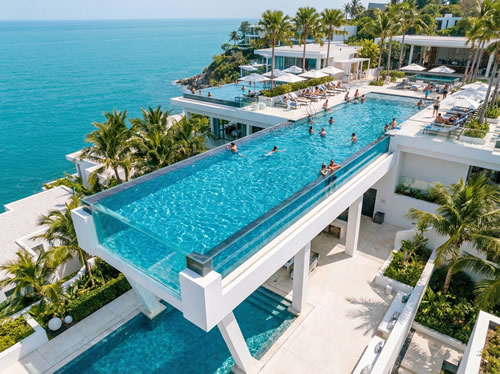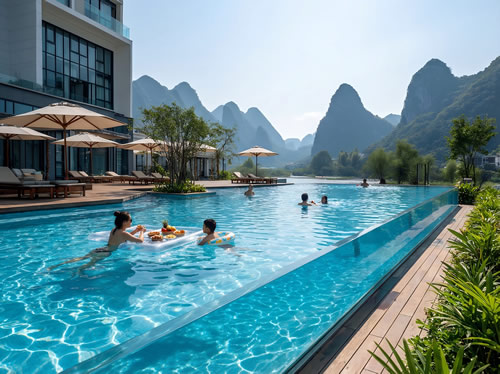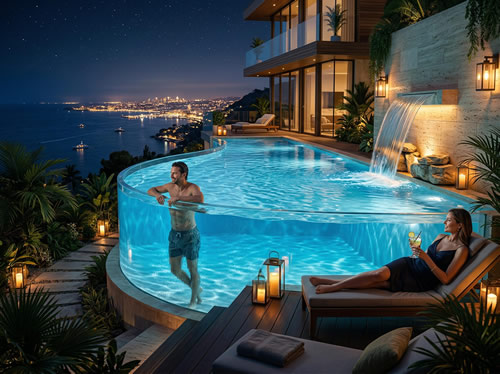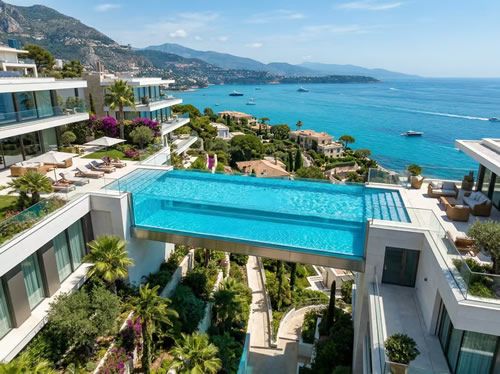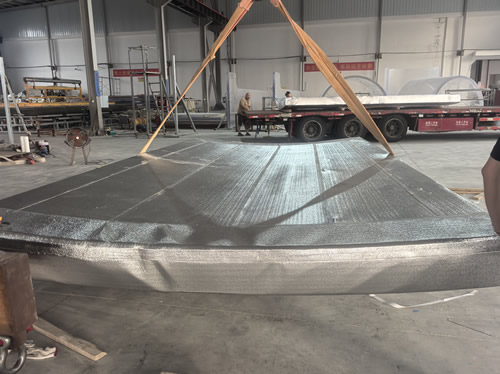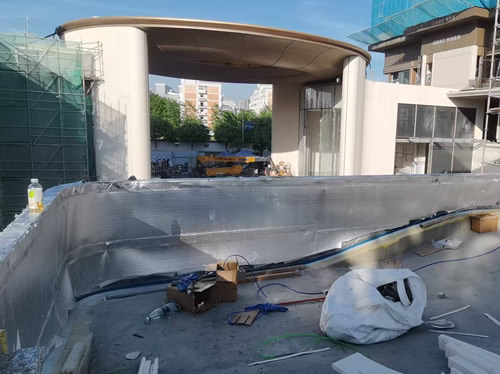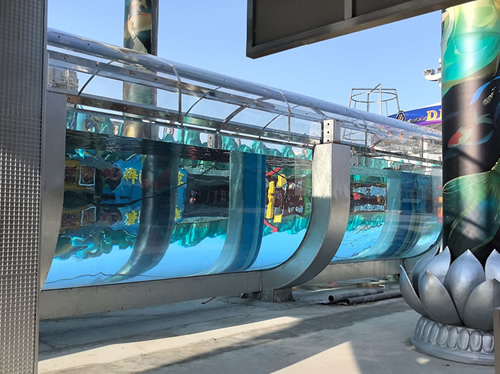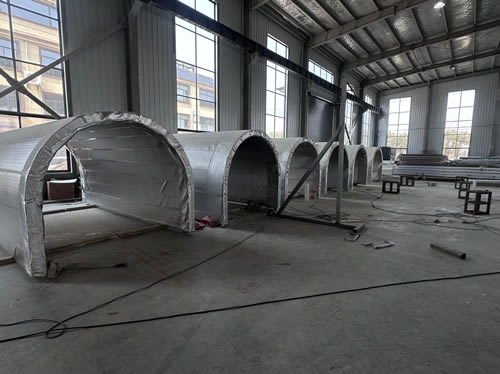



Direct Answer: This is an ongoing curved scenic acrylic pool project. We provide pool design development, custom transparent cast PMMA acrylic panels, thermoforming, on-site lifting and positioning, joint sealing, staged water filling tests, and handover. Transparency is only the finished appearance. Long-term performance is determined by structural calculations, panel quality, civil construction accuracy, support joints, thermal expansion allowance, sealing processes, and staged hydrostatic testing.
Because the project is still under construction and subject to a confidentiality agreement, the project name, location, owner, and specific parameters are not disclosed. This article shares only publicly available technical points of curved scenic acrylic pools.
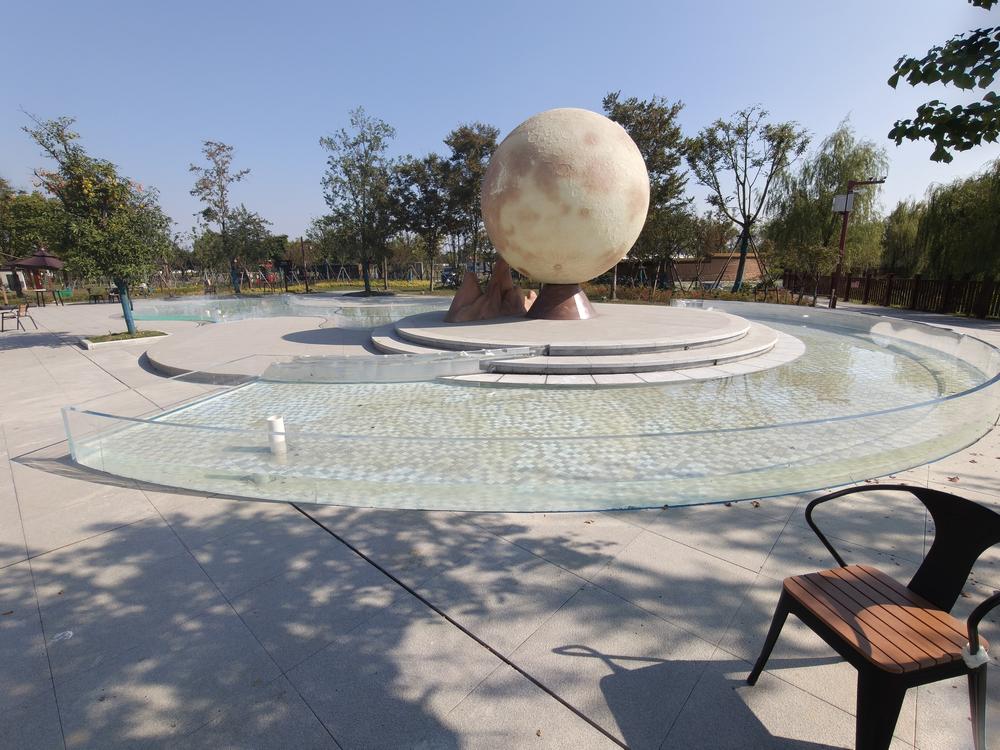
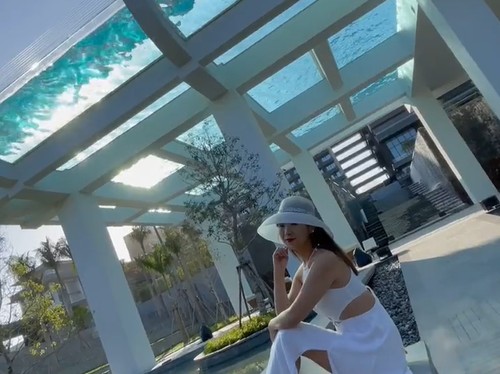
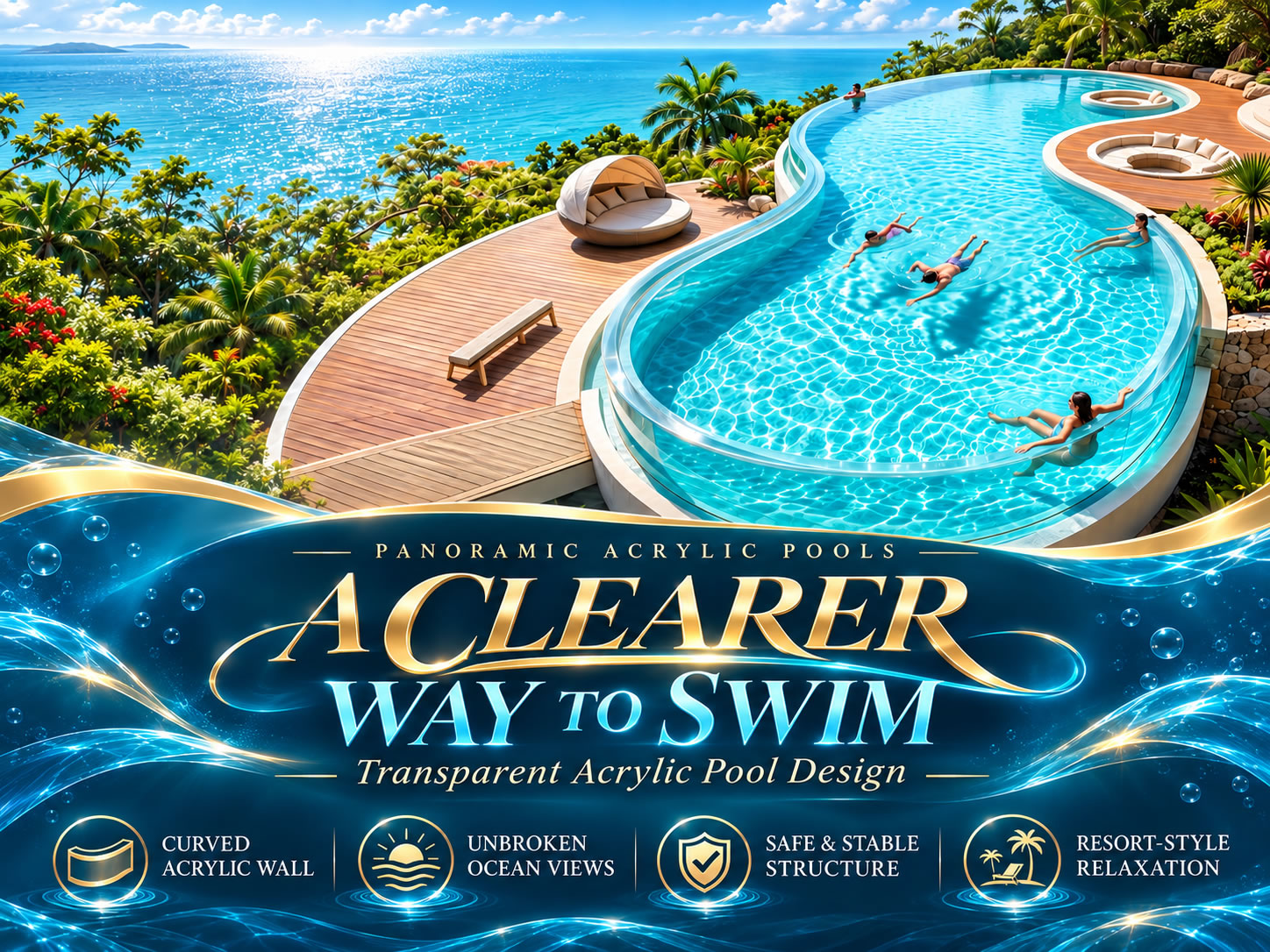
The themed installation, free-form curved pool, transparent viewing walls, and landscaped pathways form a complete scenic water feature.
The project is located in an outdoor scenic area. The water body wraps around a central themed platform. The pool uses a free-form curved layout, and the transparent viewing walls extend continuously along the walkway. Visitors can view the water surface and mosaic pool floor from above, or observe the water from the side through the acrylic panels. The project therefore serves four functions: themed landscape, visitor circulation, photography and social media, and spatial identity.
Scenic transparent pools are custom engineering projects. Pool wall curvature, panel thickness, transparent opening length, support method, embedment groove dimensions, sealing joints, and lifting paths must be designed together. Simply purchasing an “adequately thick” acrylic panel does not automatically produce a safe, clear, and durable transparent pool.
| Item | Currently Confirmable Information | Significance for Clients |
|---|---|---|
| Project Type | Scenic themed acrylic pool / transparent water feature | Creates a viewable and shareable landscape node |
| Pool Form | Free-form curved, wrap-around layout | Can be customized to match themed installations and landscape circulation |
| Transparent Material | High-transparency cast PMMA acrylic viewing panels | Allows direct viewing of water and pool floor layers from outside |
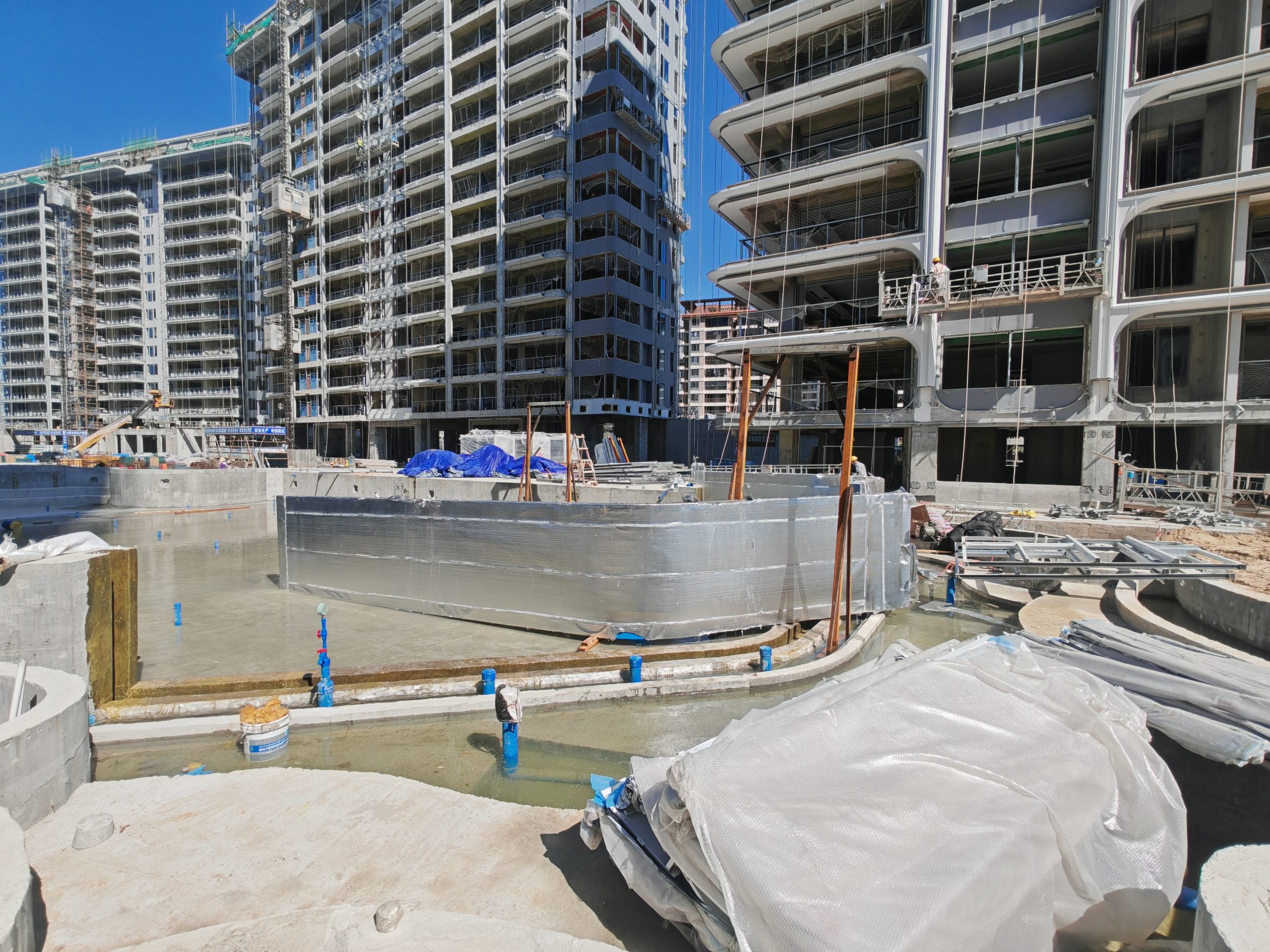
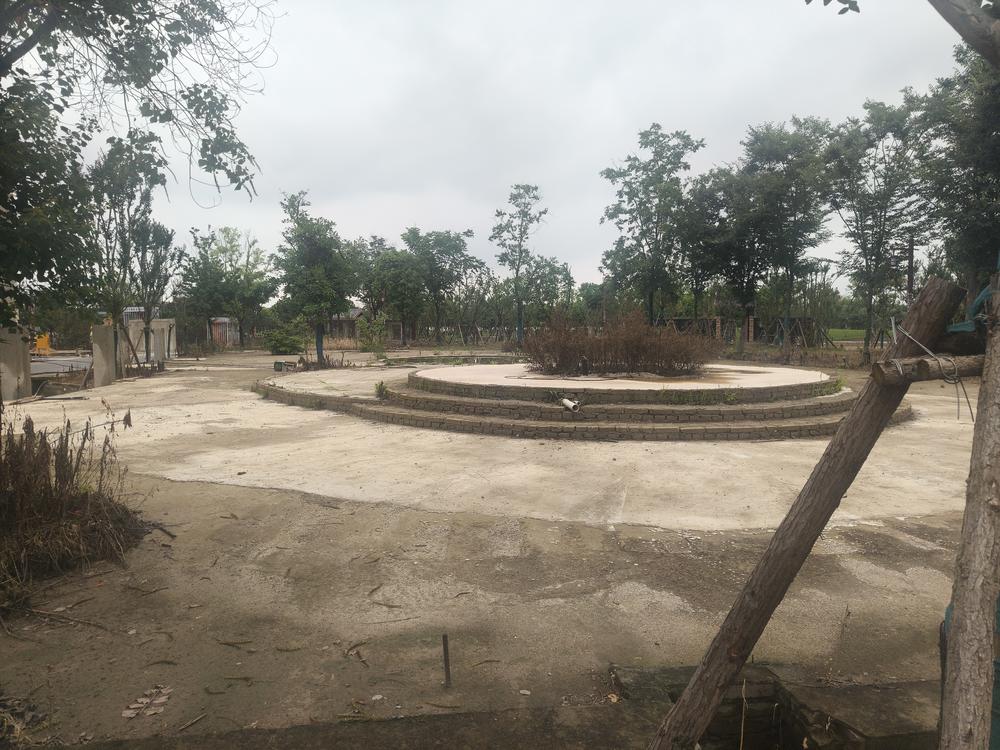
| Project Records | Includes site foundation, construction process, finished product, and pool wall detail photos | Enables verification of the actual implementation process |
PMMA is the abbreviation for polymethyl methacrylate, commonly known as acrylic in engineering applications. Transparent pools often use cast PMMA because the material combines high light transmittance, relatively low weight, weather resistance, and forming capability. It can be used to produce flat panels, curved panels, and custom geometric viewing surfaces. Published technical data shows that the typical total light transmittance of clear cast acrylic standard specimens is 92%, with a specific gravity of 1.19. Acrylic of the same thickness weighs approximately half as much as glass.
These material data only describe the basic properties of PMMA and cannot directly replace panel thickness calculations for pools. Transparent pool walls are subjected to long-term water pressure. Design must also consider opening span, water depth, curvature, support boundaries, allowable deflection, temperature differentials, sustained loads, and safety factors. Large acrylic projects typically evaluate options through panel load calculations, support scheme comparisons, deflection checks, or finite element analysis.
| Property | Typical Value | Test Method / Basis | Implication for Pool Engineering |
|---|---|---|---|
| Total light transmittance | 92% | ASTM D1003 | Helps present water, pool floor, and lighting layers clearly |
| Specific gravity | 1.19 | ASTM D792 | Affects panel weight, transportation, and lifting plans |
| Tensile strength | 69 MPa | ASTM D638 | Basic material value; design must still use allowable values and safety factors |
| Flexural strength | 114 MPa | ASTM D790 | Cannot be judged independently of panel thickness, span, and support conditions |
| Coefficient of linear thermal expansion | 0.000072 m/(m·°C) | ASTM D696 | Joints and grooves must provide allowance for thermal movement |
| 24-hour water absorption | 0.2% | ASTM D570, near 23°C | Long-term water exposure still requires project-specific evaluation of dimensions and joints |
| Recommended continuous service temperature limit | 82°C | Manufacturer recommended value | Material boundary value; not the normal operating water temperature of a pool |
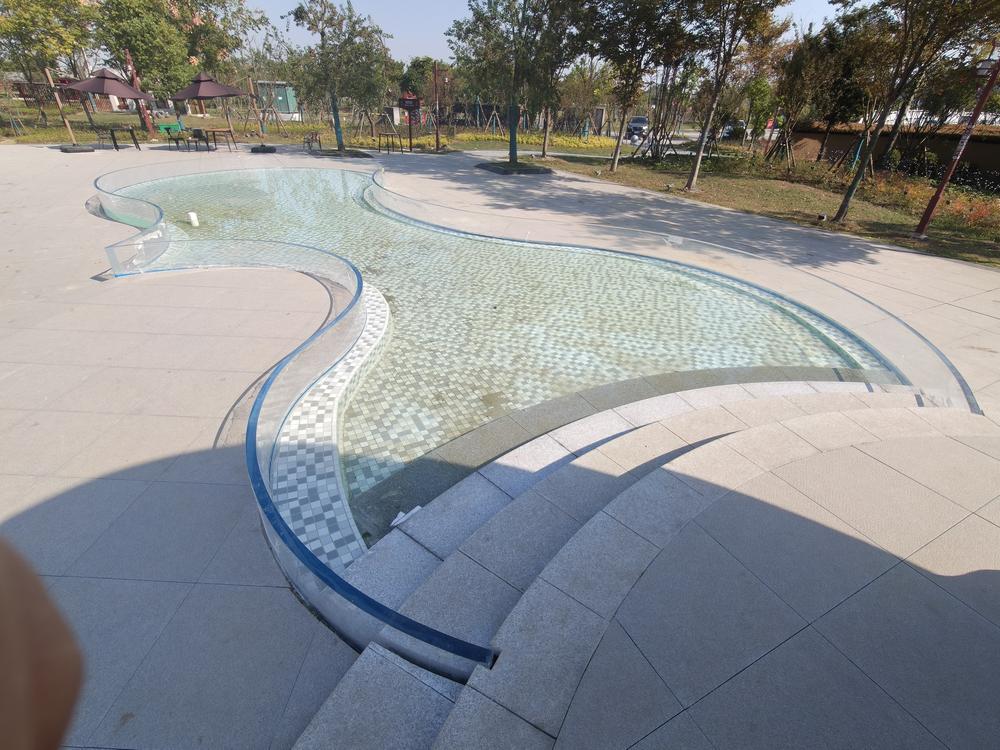
Acrylic pool construction cannot manage civil works, panels, and waterproofing separately. Deviations in embedment grooves, uneven foundations, improper lifting loads, or incomplete joint treatment will affect transparency, sealing, and long-term performance. We organize construction according to the logic of “calculate first, then produce; verify the groove first, then lift; cure first, then fill with water.”
| Stage | Main Work | Key Checks | Deliverables |
|---|---|---|---|
| 1 | Site survey, setting-out, and design development | Elevations, curve radii, transparent openings, lifting access | Survey records, detailed drawings |
| 2 | Water pressure, panel thickness, deflection, and support joint calculations | Water depth, clear span, boundaries, sustained loads, temperature differentials | Calculation reports, joint drawings |
| 3 | Reinforced concrete pool structure and load-bearing foundation construction | Foundation strength, groove dimensions, flatness, verticality | Concealed-work inspection records |
| 4 | Circulation piping, drainage, lighting reservations, and waterproofing | Pipe pressure, wall penetrations, waterproofing continuity | Pipe testing, waterproofing acceptance |
| 5 | PMMA panel forming, machining, polishing, and pre-assembly | Dimensions, curvature, surface, edges, batch records | Inspection records, material certificates |
| 6 | Special packaging, transportation, lifting, and temporary protection | Lifting points, loads, collision risk, protective film, site access | Lifting plan, delivery inspection |
| 7 | Precise positioning, support adjustment, joining, and sealing | Uniform support, concentrated stress, thermal expansion allowance, sealing integrity | Installation records, joint photos |
| 8 | Cure according to process requirements; staged water filling and observation | Leakage, displacement, deflection, joint condition, water level changes | Water filling test records |
| 9 | Final finishing, cleaning, equipment commissioning, and handover training | Appearance, water quality, circulation, maintenance tools and cleaner compatibility | Handover checklist, maintenance instructions |
On-site installation of large panels typically involves specialized lifting, positioning of oversized components, precise alignment, and on-site joining. These steps directly affect fit, optical performance, and structural integrity.
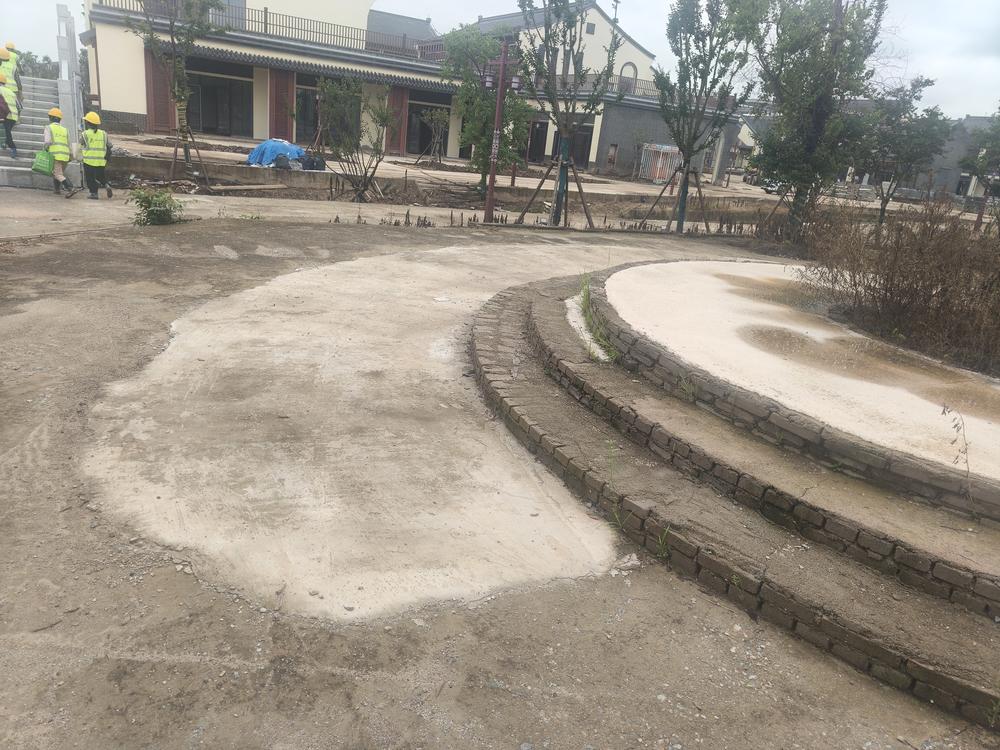
Material selection for transparent pools should not be based solely on price per square meter. Buyers need to compare material weight, formable curvature, support structure, transportation and lifting, joint types, allowable deflection, maintenance methods, and whole-life cost. The following are commonly used comparison dimensions during the design stage.
| Comparison Item | Cast PMMA Acrylic Panels | Tempered Laminated Glass for Pools | Selection Guidance |
|---|---|---|---|
| Optical clarity | Typical total light transmittance of 92% for clear cast standard specimens | Affected by glass type, iron content, thickness, and number of layers | Compare actual samples for thick panels and large viewing areas |
| Weight and lifting | Approximately half the weight of glass at the same thickness | Higher density; thick, heavy components place greater demands on lifting and supports | Calculate based on actual thickness, component size, and transport route |
| Curved forming capability | Can be thermoformed; suitable for free-form curves and custom geometry | Curved surfaces usually require specialized heat bending, tempering, or lamination processes | Complex curves should prioritize manufacturability assessment |
| Stiffness and long-term deflection | Lower stiffness than glass; deflection, sustained loads, and thermal movement must be checked | Higher stiffness, but brittle failure and glass construction requirements must be addressed | Determined by professional structural design; do not select thickness based on experience alone |
| Joints and visual continuity | Can use single-piece forming or professional chemical bonding for continuous viewing | Usually limited by single-panel size, lamination, framing, and sealant joints | Extra-long projects should evaluate production, transport, and on-site joining together |
| Maintenance | Requires soft tools and compatible cleaners; avoid incompatible solvents | Generally higher scratch resistance; sealant joints and edges still need protection | Include maintenance procedures in handover training |
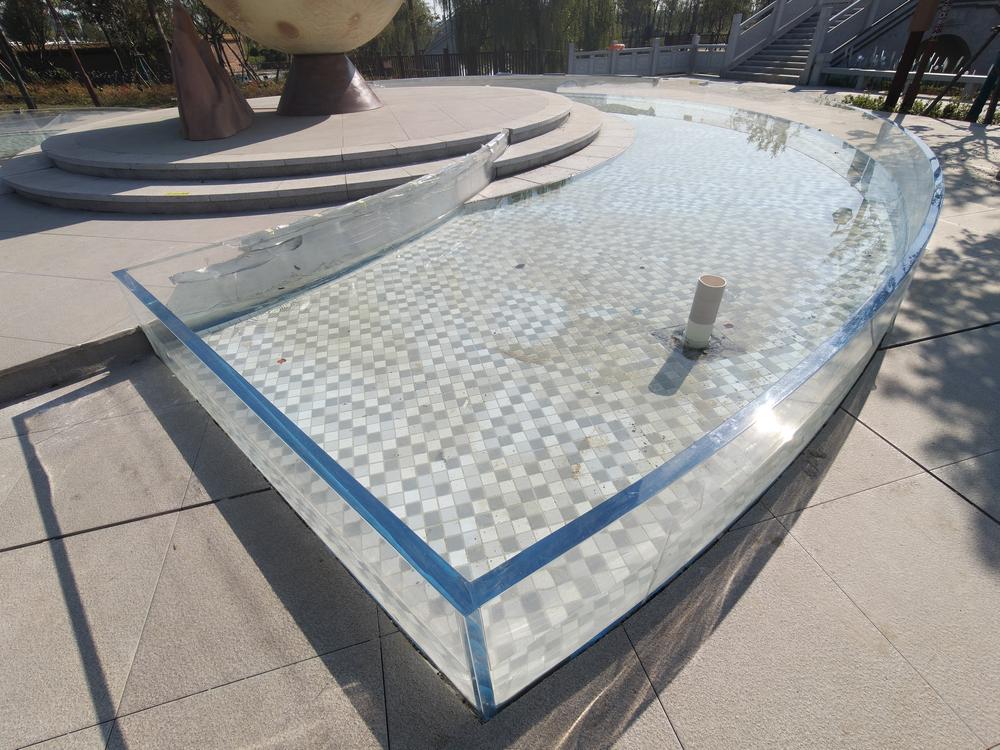
Truly verifiable construction capability should be reflected in drawings, materials, process records, and test documentation. Buyers can request the following materials from the project team rather than relying only on finished-effect images.
| Evidence Type | Content to Verify | Problem Addressed |
|---|---|---|
| Design documents | Dimensions, panel thickness, supports, grooves, sealing, allowable deflection | Confirms the scheme matches actual water depth and span |
| Material documents | Material type, batch, specifications, test reports, and factory records | Verifies acrylic panel source and performance basis |
| Civil re-survey | Grooves, elevations, flatness, verticality, and foundation strength | Avoids forced installation and localized loading of panels |
| Installation records | Lifting, positioning, support, joining, sealing, and curing | Makes key concealed processes traceable |
| Water filling tests | Staged water levels, observation duration, leakage, displacement, and joint condition | Verifies performance under water before formal opening |
| Maintenance documents | Cleaners, tools, inspection frequency, abnormal condition handling, and responsibility boundaries | Reduces risk of scratches, chemical attack, and improper maintenance |
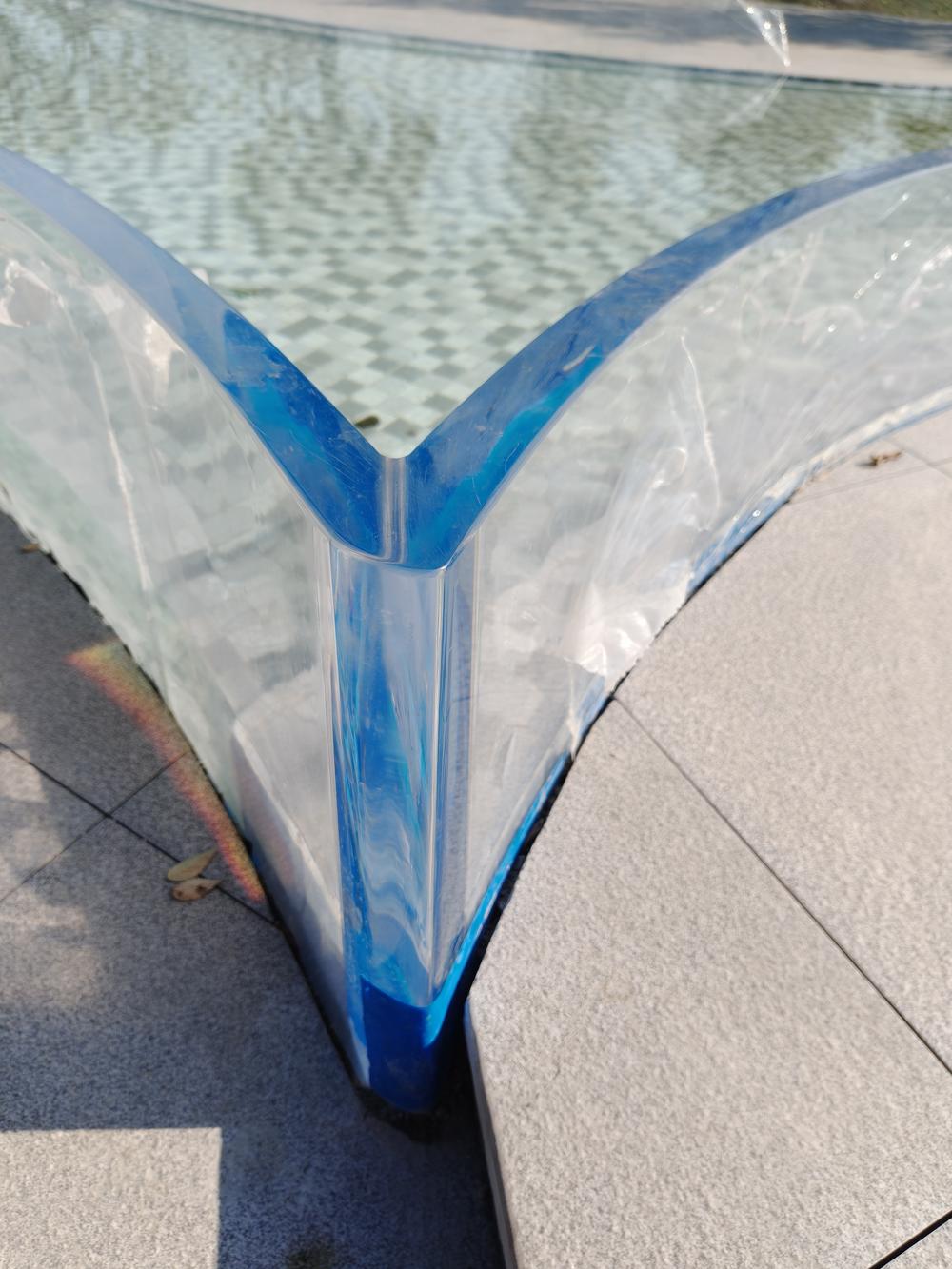
There is no universal thickness independent of project conditions. Thickness must be calculated based on design water depth, clear span of the transparent opening, panel curvature, four-edge support method, allowable deflection, long-term water pressure, temperature differentials, and safety factors. A quotation that only gives a price per square meter without confirming these parameters is incomplete.
Large acrylic panels should avoid undesigned point-type rigid fastening. Holes and localized contact can create concentrated stress, and the material expands and contracts with temperature changes. Published material guidelines recommend designed frame grooves and continuous supports for large panels, with allowance for expansion and contraction.
This needs to be explained accurately based on component size. Components that can be cast or formed as a single piece can reduce visible joints. Extra-long or complex projects may also use professional chemical polymerization joining to form continuous viewing surfaces from multiple panel sections. The goal of professional joining is to control both visual continuity and structural integrity.
First rinse with clean water to remove sand particles, then use soft tools and cleaners approved by the material supplier. Avoid dry wiping, and do not use acetone, benzene, toluene, chlorinated hydrocarbons, ketones, or high-concentration alcohol, which may attack PMMA. Actual maintenance should follow the material compatibility list provided at project handover.
Acrylic pools are not suitable for price comparison based only on surface area. Cost is typically determined by panel size and thickness, flat or curved panels, transparent opening span, fabrication and polishing, joining method, support structure, transport distance, lifting conditions, on-site installation, and hydrostatic testing. A meaningful engineering quotation can only be prepared after water depth, opening dimensions, site photos, and architectural drawings are provided.
It is recommended to first provide the project city, usage scenario, plans and sections, design water depth, transparent surface length and height, flat or curved panel requirements, civil construction progress, delivery access, lifting conditions, and planned construction duration. The more complete the information, the more accurate the panel thickness, joints, fabrication, and construction scheme will be.